
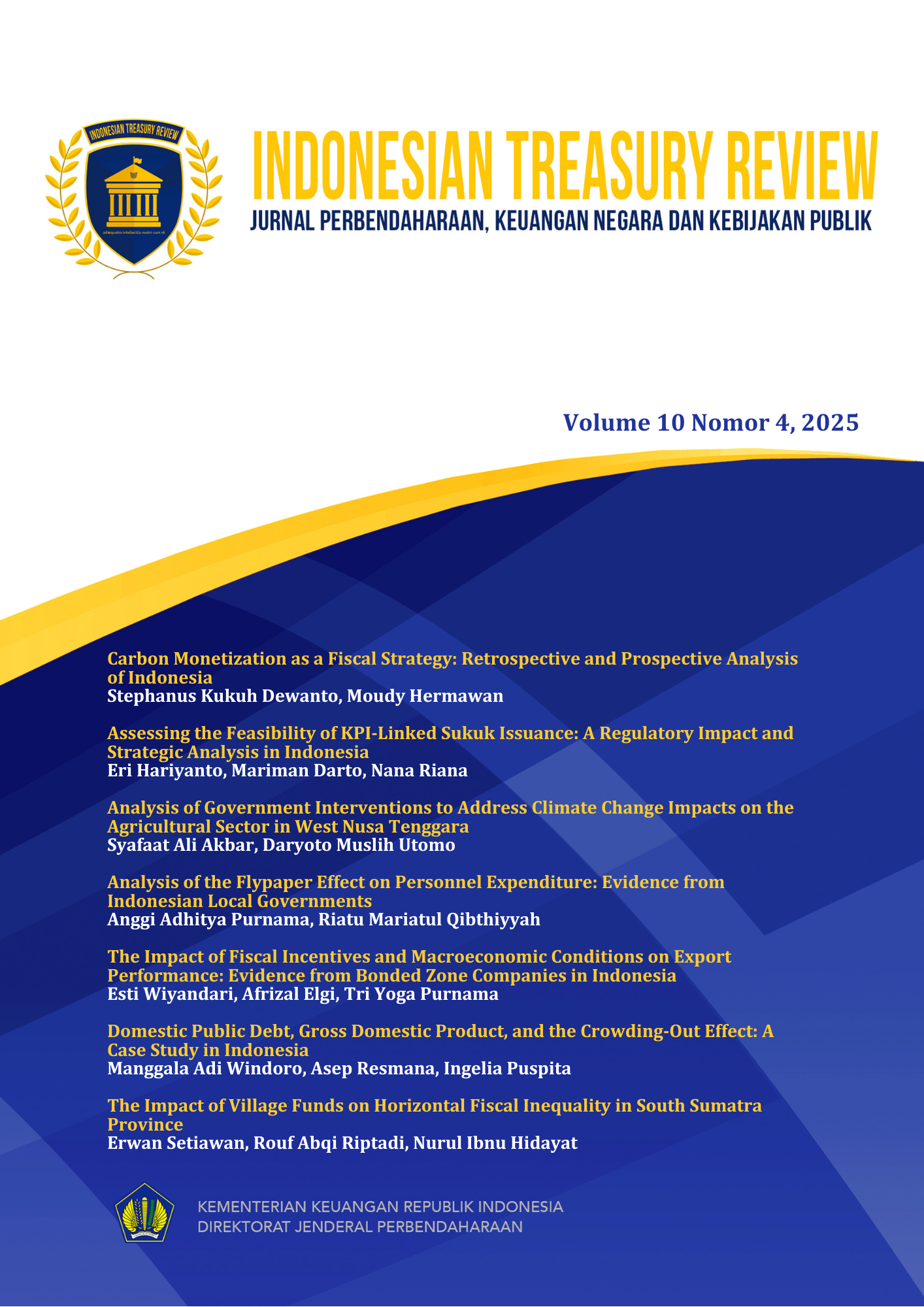
Domestic Public Debt, Gross Domestic Product, and the Crowding-Out Effect: A Case Study in Indonesia
Article Sidebar
-
Crowding Out, Deficit, Domestic Debt, General Government, Government Finance Statistics, Gross Domestic Product
Abstract
Research Originality — Several studies have examined the impact of government debt on Indonesia’s GDP, but few have specifically analyzed the effect of domestic debt. This study addresses that gap by focusing on general government domestic debt securities and loans, measured by creditor’s residency, which is rarely explored in previous research.
Research Objective — This study aims to assess how domestic debt from both central and local governments (general government) affects Indonesia’s GDP and whether it leads to a crowding-out effect on private investment.
Research Methods — The study adopts the error correction model (ECM) to analyze short-term and long-term relationships between variables. The analysis uses quarterly data from Q1 2014 to Q4 2019.
Empirical Results — The results show that the growth of general government domestic debt has a positive and significant impact on Indonesia’s economic growth. Moreover, it does not lead to a crowding-out effect on private investment.
Implications — The general government’s shift toward domestic debt as the primary financing source is appropriate and contributes to reducing insolvency risks. Nevertheless, prudent debt management is crucial, and domestic debt should be optimized for strategic expenditures such as infrastructure, health, and education. Indonesia’s economy is currently operating below its full capacity, thereby providing the general government with room to implement effective long-term economic stimulus measures.
Full text article
References
Alshammary, M. D., Karim, Z. A., Khalid, N., & Ahmad, R. (2020). Debt-Growth Nexus in the MENA Region: Evidence from a Panel Threshold Analysis. Economies, 8(4), 1–12. https://doi.org/10.3390/ECONOMIES8040102
Asravor, R. K., Arthur, L. A., Acheampong, V., Lamptey, C., & Yeboah, M. (2023). Domestic debt sustainability and economic growth: Evidence from Ghana. Research in Globalization, 7(March), 100144. https://doi.org/10.1016/j.resglo.2023.100144
Ayres, J., Navarro, G., Nicolini, J. P., & Teles, P. (2018). Sovereign default: The role of expectations. Journal of Economic Theory, 175, 803–812. https://doi.org/10.1016/j.jet.2018.02.006
Bukit, A. R., & Anggraeni, L. (2017). Domestic government debt and economic growth in Indonesia: An empirical analysis. International Convergence Management Association, 5(1), 27–37. https://doi.org/10.20482/jemm.2017.5.1.3
Cao, Y., Jiang, W., Lam, W. R., & Wang, N. (2025). Maximum Sustainable Debt Across Countries : https://doi.org/10.5089/9798229028820.001
Dhoni, D. (2018). Evaluasi penerapan manajemen risiko pada strategi pengelolaan utang: Studi kasus pemerintah Indonesia periode 2005 - 2014. Indonesian Treasury Review Jurnal Perbendaharaan Keuangan Negara Dan Kebijakan Publik, 3(2), 109–128. https://doi.org/10.33105/itrev.v3i2.68
Diarra, I., Guillard, M., & Kempf, H. (2025). Sovereign Defaults and Debt Sustainability: A joint analysis. Open Economies Review, 36, 1365–1412. https://doi.org/10.1007/s11079-025-09806-8
Elmendorf, D. W., & Mankiw, G. N. (1999). Government debt. In Handbook of Macroeconomics. Harvard University.
Fakhruddin, N. D. (2023). Causality analysis of government debt and economic growth in Indonesia, 1990 – 2020. Proceedings of the Perbanas International Seminar on Economics, Business, Management, Accounting and IT (PROFICIENT), 1(1).
Huynh, N., Phan, H., Paquette, K., & Vu, P. T. T. (2025). Sovereign credit ratings, fiscal burden and corporate investment policies: An international evidence. Research in International Business and Finance, 82. https://doi.org/10.1016/j.ribaf.2025.103228
International Monetary Fund. (2014). Government finance statistics manual 2014. Washington DC: Author.
Johri, A., Khan, S., & Sosa-Padilla, C. (2022). Interest rate uncertainty and sovereign default risk. Journal of International Economics, 139, 103681. https://doi.org/10.1016/j.jinteco.2022.103681
Jusaj, Y., Avdimetaj, K., Zogaj, V., & Gara, A. (2025). The impact of public debt threshold on economic growth before and after the COVID-19 Pandemic: An Empirical Analysis of Central and Eastern European Developing Countries. Economics and Culture, 22(1), 123–135. https://doi.org/10.2478/jec-2025-0010
Keho, Y. (2025). Does budget deficit crowd out private investment ? Cote d’Ivoire as a focus. International Journal of Economics and Finance, 16(2), 86–98. https://doi.org/10.5539/ijef.v16n2p86
Kose, M. A., Nagle, P., Ohnsorge, F., & Sugawara, N. (2021). Benefits and costs of debt: The dose makes the poison. Global Waves of Debt: Causes and Consequences, February, 45–77. https://doi.org/10.1596/978-1-4648-1544-7_ch2
Kurniasih, E. P. (2021). The effect of foreign debt on the economic growth. Jurnal Ekonomi Malaysia, 55(3), 125–136. https://doi.org/10.17576/JEM-2021-5503-09
Lindgren, J. (2021). Examination of interest-growth differentials and the risk of sovereign insolvency. MDPI, 9(4), 75. https://doi.org/10.3390/risks9040075
Lorenzoni, G., & Werning, I. (2019). Slow moving debt crises. American Economic Review, 109(9), 3229–3263. https://doi.org/10.1257/aer.20141766
Mankiw, N. G. (2010). Macroeconomics (Seventh Ed). New York: Worth Publishers.
Marisha, E. (2024). Understanding cointegration and error correction models in financial econometrics. Journal of Entrepreneurship & Organization Management, 13, 12–13. https://doi.org/10.37421/2169-026X.2024.13.454
Ministry of Finance. (2010). Peraturan Pemerintah Republik Indonesia Nomor 71 Tahun 2010 tentang Standar Akuntansi Pemerintahan. Jakarta: Author.
Ministry of Finance. (2017). Rancangan Anggaran Pendapatan dan Belanja Negara, Dana Pihak Ketiga, dan Crowding Out Effect. Warta Fiskal, Edisi IV.
Ministry of Finance. (2021). Kaleidoskop APBN Kita 2021. In APBN Kita. https://www.kemenkeu.go.id/apbnkita
Mitsi, D. (2025). Public debt and economic growth in the European Union : Threshold effects and debt sustainability in a dynamic panel framework. International Journal of Economics and Finance, 17(10), 1–15. https://doi.org/10.5539/ijef.v17n10p1
Mun, M. W., & Ismail, N. W. (2015). The impact of domestic public debt on financial development in Malaysia. International Journal of Social Science Research, 3(2). https://doi.org/10.5296/ijssr.v3i2.7167
Munthe, S. A. (2024). Journal the effects of budget deficit and Indonesia external debt on economic growth in Indonesia From 2004 To 2022. International Journal of Current Economics & Business Ventures, 4(1), 84–100. https://scholarsnetwork.org/journal/index.php/ijeb
Narayan, P. K., Ismail, A. S., Saudulla, M. I., & Rizvi, S. A. R. (2025). Debt sustainability and the effectiveness of fiscal policy tools - The case of the Maldives. Economic Analysis and Policy, 86, 1377–1390. https://doi.org/10.1016/j.eap.2025.04.013
Ncanywa, T., & Masoga, M. M. (2018). Can public debt stimulate public investment and economic growth in South Africa? Cogent Economics and Finance, 6(1), 1–13. https://doi.org/10.1080/23322039.2018.1516483
Nguyen, V. B. (2022). The crowding-out effect of public debt on private investment in developing economies and the role of institutional quality. Seoul Journal of Economics, 35(4). https://doi.org/10.22904/sje.2022.35.4.003
Ostry, J., Ghosh, A., & Espinoza, R. (2015). When Should Public Debt Be Reduced? Staff Discussion Notes, 15(10), 1. https://doi.org/10.5089/9781498379205.006
Park, J. K., & Meng, X. (2024). Crowding out or crowding in? Reevaluating the effect of government spending on private economic activities. International Review of Economics & Finance, 89, 102–117. https://doi.org/10.1016/j.iref.2023.07.099
Peia, O., Vranceanu, R., & Bousselmi, W. (2024). Strategic and insolvency risk in sovereign debt pricing: An experimental study. ESSEC Business School Research Paper. https://doi.org/10.2139/ssrn.5028983
Prihandoko, H. (2017). Percepatan Pembangunan infrastruktur dan penambahan utang luar negeri pemerintah: Potensi manfaat vs potensi risiko. Indonesian Treasury Review Jurnal Perbendaharaan Keuangan Negara Dan Kebijakan Publik, 2(4), 1–14. https://doi.org/10.33105/itrev.v2i4.41
Samwel, M. (2016). Do budget deficit crowds out private investment : A case of Tanzanian economy. International Journal of Business and Management, 11(6), 183–193. https://doi.org/10.5539/ijbm.v11n6p183
Saungweme, T., & Odhiambo, N. M. (2021). Relative impact of domestic and foreign public debt on economic growth in South Africa. Journal of Applied Social Science, 15(1), 132–150. https://doi.org/10.1177/1936724420980414
Sekarani, R. A. A. F., Sugema, I., & Pasaribu, S. H. (2024). Rethinking domestic debt: Implications for Indonesia’s financial sector. Jurnal Ekonomi Pembangunan, 22, 171–188. https://doi.org/10.29259/jep.v22i2.23187
Shaari, M. S., Masnan, F., Abd Rani, M. J., Zainal Abidin, Z., Ridzuan, A. R., & Othman, N. (2023). The grim cost of economic growth and environmental degradation: A Comprehensive Panel ARDL Study of Public Debt in the ASEAN-5 Countries. Sustainability (Switzerland), 15(14). https://doi.org/10.3390/su151410756
Sheskin, D. J. (2004). Parametric and nonparametric statistical procedures (3rd ed). A CRC Press Company.
Statistics Indonesia Salatiga Municipality. (2024). Metodologi PDRB pengeluaran. https://salatigakota.bps.go.id/subject/156/produk-domestik-regional-bruto--pengeluaran-.html#subjekViewTab1
Sudarma, I. M., & Yasa, I. N. A. (2021). The contribution of external debt to economic growth: An empirical investigation in Indonesia. Journal of Asian Finance, Economics and Business, 8(10), 11–17. https://doi.org/10.13106/jafeb.2021.vol8.no10.0011
Sukma, I., & Anwar, K. (2021). The effect of foreign investment, government external debt, and government expenditure on gross domestic product in Indonesia. Journal of Malikussaleh Public Economics, 4(1), 20. https://doi.org/10.29103/jmpe.v4i1.4790
Sunder-Plassmann, L. (2020). Inflation, default and sovereign debt: The role of denomination and ownership. Journal of International Economics, 127. https://doi.org/10.1016/j.jinteco.2020.103393
Suryandaru, R. A. (2023). The Relationship Between Public Debt, Trade Openness, and Economic Growth in Indonesia: Symmetric and Asymmetric Analysis. Thailand and the World Economy, 41(1), 35–60.
Triatmanto, B., Bawono, S., & Wahyuni, N. (2023). The contribution and influence of total external debt, FDI, and HCI on economic growth in Indonesia, Thailand, Vietnam, and Philippines. Research in Globalization, 7(October), 100163. https://doi.org/10.1016/j.resglo.2023.100163
Viphindrartin, S., Wilantari, R. N., Zainuri, Kristiawan, R., Bawono, S., & Ariansyah, G. (2023). Public debt and macroeconomic dynamics: A simulation model with variables of interest rate, economic growth, domestic consumption, government expenditure, and net exports (Issue Tceeis). Atlantis Press International BV. https://doi.org/10.2991/978-94-6463-346-7_30
Viziniuc, M. (2021). Winners and losers of central bank foreign exchange interventions. Economic Modelling, 94, 748–747. https://doi.org/10.1016/j.econmod.2020.02.016
Wen, X., Li, W., & Shen, Z. (2024). Local government debt and corporate asset-debt maturity mismatches: Evidence from China. China Economic Review, 88(102269). https://doi.org/10.1016/j.chieco.2024.102269
Widjanarko, W. (2020). Determinan Kenaikan Rasio Utang Indonesia Periode 2012-2019. Indonesian Treasury Review: Jurnal Perbendaharaan, Keuangan Negara Dan Kebijakan Publik, 5(3), 183–191. https://doi.org/10.33105/itrev.v5i3.215
Zend, A. S. (2022). Utang publik dan pertumbuhan ekonomi daerah di Indonesia. Indonesian Treasury Review Jurnal Perbendaharaan Keuangan Negara Dan Kebijakan Publik, 7(4), 317–328. https://doi.org/10.33105/itrev.v7i4.526
Authors
Copyright (c) 2025 Indonesian Treasury Review: Jurnal Perbendaharaan, Keuangan Negara dan Kebijakan Publik

This work is licensed under a Creative Commons Attribution 4.0 International License.
Copyright notice can be accessed here